


Community Cultivators: Mount Horeb Farmers Grow Relationships Beyond the Field

Written by Hannah Alden, Communications Specialist
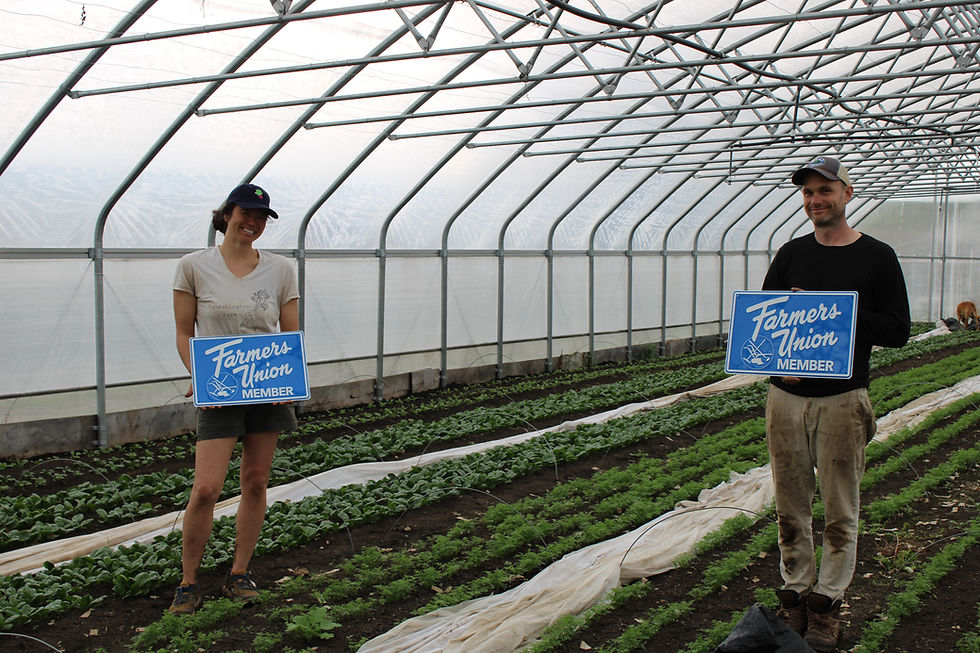
On a warm, breezy day in mid-April, Sarah Leong and Patrick Hager were busy planting onions with their field crew. Tucked away off the hilly backroads just outside of Mount Horeb, Sarah and Pat’s Squashington Farm is known not only for producing a plethora of vegetable varieties but also for cultivating community.
The couple met in 2012 while working on a trail crew in the Adirondacks of New York. Sarah, raised in Florida, had never experienced a northern winter. As their friendship turned into a romance, Sarah enthusiastically agreed to accompany Pat back to Wisconsin’s Fox Valley region, where he was raised, after their trail jobs ended.
After a stint in Alaska as whitewater rafting and whale watching guides, Sarah and Pat landed in the Dane County area to take over managing Yesteryear Farm for one of Pat’s friends in 2013. The following year, the couple traded their labor for an acre on that farm to kick off their own vegetable production, selling at the Mount Horeb Farmers Market and through Madison area restaurant wholesale accounts.
In 2016, Pat and Sarah officially launched Squashington Farm, as they rented additional land and inherited about 20 of Yesteryear’s CSA customers after their farmer friends moved to a different part of the state. Some of those original CSA customers remain as part of Squashington’s almost 200-member program today.
Now with about three acres in vegetable production on their own 20-acre property, Sarah and Pat agree that diversity is the key to their farm. The couple grows over 200 different varieties of produce on their land. In the past, they also offered a flower CSA and raised animals, but have centered their focus on certified organic vegetable production.
In addition to CSA and on-farm sales, Squashington Farm vends at the Mount Horeb and Dane County Farmers Markets, along with providing items to chefs and others through wholesale accounts. Becoming more interwoven within the Madison food scene has been a big boost for the farm, according to Pat.
“We’ve started to feel that we’re becoming part of something bigger, that historical part of Madison’s culture,” he said. “That’s cool, but it can be exhausting, too.”

Being away at markets and traveling to make sales can sometimes take away from field tasks and free time. With two daughters now on the landscape with them, Pat and Sarah have had to get creative with childcare and managing their time to make things work. They offer a childcare “sitter share” exchange, which offers folks the chance to trade a weekly shift caring for their kiddos for a share of produce. Despite the challenges – including carrying a child on her back while completing farm projects – Sarah said she wouldn’t trade the experience of raising their kids on the farm for anything.
“They know what food is and where it comes from and understand seasonality so much more than I ever did,” Sarah said. “It’s been a real joy and honor to see the world through that lens, especially on a farm.”
Along with the equity the farm is helping to build for their family, Squashington has also become a place for their farm employees, CSA members, and neighbors to come together as an extended type of family.
Yearly gatherings, such as the farm’s barn dance, have been a highlight for Sarah and Pat as they welcome people from all ages and backgrounds to gather and enjoy connection to the land.
“For millennia, people have been physically and materially tied to the land,” Sarah said. “Now in this day and age, your food comes from all over, all the time, all year. We’re missing that connection.”
To help further promote that important link to agriculture, Sarah has recently stepped up beyond the farm’s borders to make their voices heard. She serves on the FairShare CSA Coalition Board, and has attended multiple WFU Lobby Days, which has made her “want to do more.”
“I really appreciate Farmers Union’s platforms and its leverage,” Sarah said. “It’s a renowned organization with a good microphone.”
Pat and Sarah, now in their 13th year farming together, attribute a lot of their success to the support of their community. At the beginning, they had less than $1,000 in savings and an old (but reliable) red farm truck.
“Mount Horeb is why we were able to keep farming,” Pat said. “When we first started, we went to markets all over… None of them showed up like Mount Horeb.”
As they continue to strengthen their farm and relationships, Sarah hopes Squashington can also serve as an educational space for the next generation.
“I’m hoping that we get to be part of this next wave of established farms bringing new farmers into the fold,” Sarah said. “… [A connection to] Squashington is often a big overlap between people and that shows the important community aspect of relying on the people around you.”


Comments